
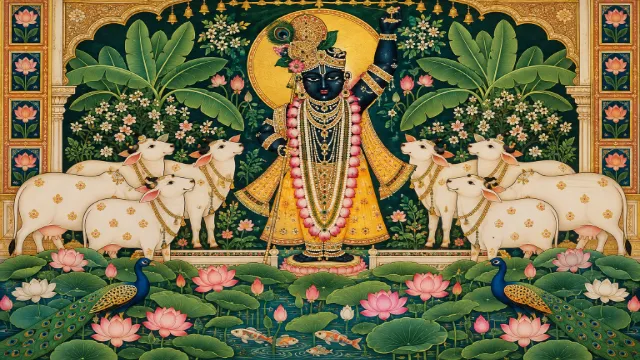
Pichhwai paintings are traditionally large cloth hangings placed behind the image of a deity in a temple. The tradition is closely associated with Shrinathji, the form of Krishna worshipped at Nathdwara, a town in Rajasthan near Udaipur.
Pichhwai paintings are known for their detailed scenes of Shrinathji, cows, lotus flowers, peacocks, gopis and other devotional subjects. The paintings may look decorative at first, but many of the things shown in them have a connection with a particular festival, season or story from Krishna’s tradition.
Where the Tradition Began
Shrinathji is shown as a young boy with his left arm raised. The raised arm recalls the story in which Krishna lifts Govardhan Hill to protect the people of Braj from a storm sent by Indra.
The image was originally worshipped near Govardhan, close to Mathura. During the 17th century, it was taken towards Mewar during a period of conflict. The Metropolitan Museum of Art gives 1672 as the year associated with the movement of the image.
According to the traditional account, the cart carrying the image stopped at a particular place in Mewar and could not be moved further. This was understood as a sign that Shrinathji wished to remain there. A temple was established at the site, which later became known as Nathdwara.
The name Nathdwara is commonly understood as “gateway of the Lord.”
From that time, Nathdwara became an important centre of Shrinathji worship and the art associated with it.
Why There Are So Many Pichhwai Designs
The temple follows the Pushtimarg tradition associated with Vallabhacharya. In this tradition, Shrinathji is treated as a living presence. He is awakened, dressed, offered food and prepared for rest as part of the daily devotional routine.
His surroundings also change according to the season and the occasion.
The Pichhwai is part of that setting. Different cloth hangings can be used for different festivals and devotional occasions. This is one reason why there are so many different Pichhwai designs.
A painting made for one festival may look completely different from one created for another.
Painters in Nathdwara developed a distinctive style around this devotional tradition, now commonly known as the Nathdwara school of painting. The paintings were made for religious use, while devotees outside Nathdwara later commissioned works for their own homes and places of worship.
What the Subjects Mean
One of the interesting things about Pichhwai painting is that the subjects are not chosen randomly. The imagery can give you clues about the festival or occasion for which a particular work was created.
Cows
Cows are among the most familiar subjects in Pichhwai art.
They are connected with Krishna’s childhood among the cowherds and with his role as a protector of cattle. Cow imagery is especially associated with Gopashtami, a festival connected with Krishna and the care of cows.
Pichhwais associated with Gopashtami can show large numbers of cows and calves spread across the composition.
Lotus Ponds
Lotus ponds are another well-known Pichhwai subject.
A pond may be filled with lotus flowers, with fish, birds and cows appearing around it. The repeated flowers create the dense decorative appearance that many people immediately associate with Pichhwai painting.
When you look closely at a handmade painting, the individual flowers may have small differences in their shape and position. Those differences are part of the handmade process.
Annakut
Annakut is associated with the Govardhan story and is celebrated after Diwali.
According to the story, the people of Braj worshipped Govardhan Hill instead of Indra. Krishna then lifted the hill to protect them from the storm.
Annakut recalls this story through a large offering of food. Pichhwai designs associated with the occasion can therefore include elaborate food offerings arranged for Shrinathji.
Sharad Purnima
Sharad Purnima, the full-moon night of autumn, is connected with the raas lila, Krishna’s dance with the gopis.
Pichhwai designs associated with Sharad Purnima may show Krishna and the gopis beneath the full moon. The night-time setting gives these paintings a very different appearance from the bright lotus and cow scenes often seen in other Pichhwais.
Janmashtami and Other Festivals
Janmashtami celebrates the birth of Krishna and is another important occasion in the devotional calendar.
Other festivals, including Holi, also have their own imagery and traditions.
This connection between the artwork and the occasion is one of the reasons Pichhwai painting is so interesting. Once you know what to look for, the flowers, animals, figures and colours can tell you something about the occasion represented.
How Traditional Pichhwais Are Made
Traditional Pichhwais were generally made on cotton cloth.
Artists used traditional pigments and other colouring materials, and some historical examples contain gold or silver decoration. The designs can be extremely detailed, with flowers, animals, figures and decorative borders covering much of the cloth.
Many elements were drawn and painted by hand. Rows of lotus flowers or groups of cows could contain small variations from one figure to another. This is different from a mechanically printed design, where the same image is reproduced uniformly.
Pichhwai-related artworks today can also be made using embroidery, appliqué, printing and other techniques. Contemporary artists may work on paper or canvas and use materials such as acrylic colours.
For this reason, it is useful to distinguish between a traditional Pichhwai textile and a contemporary Pichhwai-inspired painting.
Pichhwai in Homes Today
Pichhwai art is now found far beyond the temple.
People hang Pichhwai-inspired paintings in living rooms, bedrooms, offices and other spaces. Artists work on paper, canvas and other surfaces, and contemporary paintings may use materials that were not part of the historical tradition.
The subjects often remain familiar: Shrinathji, cows, lotus ponds, peacocks and festival scenes.
A large cotton hanging made for a temple and an acrylic painting on paper are different objects, even when they share the same imagery. For someone buying a painting, knowing the material and technique helps them understand exactly what they are purchasing.
The Pichhwai Paintings on Him Art Gallery
I paint these artworks on paper and canvas using acrylic colours including contemporary Shrinathji-inspired paintings. They are contemporary paintings inspired by Nathdwara Pichhwai art, rather than temple textiles made using traditional methods.
I learned these art forms and paint them as a hobby. I enjoy working with the detailed patterns and devotional subjects that are characteristic of Pichhwai-inspired art.
The paintings shown on this website are generally made on 230 GSM paper. Depending on the design and level of detail, one painting takes around four to five days to complete. I usually spend about four to five hours working on it each day, which means a piece can involve roughly 16 to 25 hours of painting time.
Once the painting is finished, I apply varnish to help protect the painted surface.
I particularly enjoy painting subjects such as Shrinathji, cows and lotus flowers because they allow me to work with repeated patterns and fine details while keeping the devotional character of the artwork.
These paintings are contemporary handmade artworks inspired by the traditional Pichhwai form. They should not be confused with antique Pichhwais or traditional temple textiles.
Explore – the Pichhwai Painting Collection
Frequently Asked Questions
1.What is a Pichhwai painting?
A Pichhwai is traditionally a large cloth artwork placed behind the image of a deity in a shrine. The tradition is particularly associated with Shrinathji at Nathdwara in Rajasthan.
2.Where did Pichhwai painting originate?
Pichhwai painting is most closely associated with Nathdwara, Rajasthan, which became an important centre of Shrinathji worship and the Nathdwara school of painting.
3.Why are cows common in Pichhwai paintings?
Cows are closely connected with Krishna’s childhood and his life among the cowherds. They are also important in Pichhwai designs associated with occasions such as Gopashtami.
4.Why are lotus flowers common in Pichhwai art?
Lotus flowers are frequently used in Pichhwai compositions. They may appear in ponds along with fish, birds and other natural elements, creating the richly patterned backgrounds associated with the art form.
5.Are all Pichhwai paintings made on cloth?
Traditional Pichhwais were generally made as textile hangings, but contemporary Pichhwai-inspired artworks can be made on paper, canvas and other surfaces using modern materials.
6.What is the difference between a traditional Pichhwai and a Pichhwai-inspired painting?
A traditional Pichhwai belongs to the devotional textile tradition associated with Shrinathji and Nathdwara. A contemporary Pichhwai-inspired painting may use modern materials and surfaces while drawing its subjects and visual style from that tradition.
A Tradition That Continues
Pichhwai painting began as part of the devotional tradition surrounding Shrinathji at Nathdwara. Its flowers, cows, figures and festival scenes were connected with the stories of Krishna and the changing rhythm of the temple year.
Today, Pichhwai-inspired art has found a place in homes and collections far beyond Nathdwara.
The next time you see a Pichhwai painting, look beyond the colours and patterns. Notice the cows, lotus flowers, figures, moon and other details. They may tell you something about the story or festival behind the painting.
That connection between the artwork and the devotional tradition is what gives Pichhwai painting its distinctive character.
View the Pichhwai Painting Collection