
Madhubani painting has a way of catching your attention almost immediately. Look closely at one and you’ll find fine lines, repeated patterns, bold borders, colourful figures and very little unused space. Look even closer, and you begin to notice how much patience goes into all those small details.
For someone seeing Madhubani art for the first time, it can simply look like a beautiful Indian folk painting. But there’s much more to this tradition than its decorative appearance.
So, what exactly is Madhubani art? Where did it come from? And what’s the difference between styles like Bharni and Kachhni?
Let’s get into it.
What Is Madhubani Art?
Madhubani art, also widely known as Mithila painting, is a traditional Indian painting tradition associated with the Mithila region of Bihar.
For generations, this art was created within homes and communities and passed from one generation to the next. Traditionally, paintings were made on walls and floors, especially around festivals, ceremonies and other important occasions.
As the art form became known outside the region, artists began creating paintings on paper and other surfaces. That shift made Madhubani artwork easier to preserve, display and share with people in other parts of India and around the world.
One of the things that makes Madhubani immediately recognisable is its detailed visual style. A simple figure may be surrounded by lines, flowers, leaves, dots, geometric shapes and decorative patterns. Even small areas of the painting can carry an impressive amount of detail.
That attention to detail is part of why a handmade Madhubani painting can feel so different from ordinary printed wall décor.
Where Did Madhubani Painting Come From?
Madhubani painting comes from the Mithila region of Bihar, which is why the term Mithila painting is also commonly used.
The tradition runs deep in the region’s cultural life. Women played a central role in preserving the practice within households, passing knowledge and technique down between generations.
Traditionally, paintings were created directly on walls and floors using locally available materials. Over time, the practice grew beyond these traditional settings.
Paper became an important surface for artists, letting individual paintings travel outside the region and eventually reach galleries, collectors and art buyers across India and internationally.
Today, you’ll find Madhubani artwork in both traditional and contemporary forms. Some artists continue working in styles closely tied to tradition, while others experiment with colours, subjects and compositions.
What Does Madhubani Art Look Like?
There’s no single appearance that describes every Madhubani painting.
Different artists and styles can look quite different from one another. Still, there are a few features you’ll notice again and again.
Fine outlines matter a lot. Artists often draw the main figures first, then fill the surrounding space with patterns and smaller decorative details.
Borders are common too. A border can frame the entire composition and give the painting a finished, structured feel.
Flowers, leaves, trees, birds, fish and other animals show up frequently. Human figures and scenes from traditional life appear as well.
Then there’s pattern. Instead of leaving large areas blank, artists build up the composition using lines, dots, hatching and repeated motifs.
Look at an original painting up close, and these small details become much harder to miss.
[IMAGE — Detailed linework and patterns in a traditional Madhubani painting]
Bharni Style: Colour Takes Centre Stage
Bharni is one of the Madhubani styles many people recognise immediately, thanks to its bold use of colour.
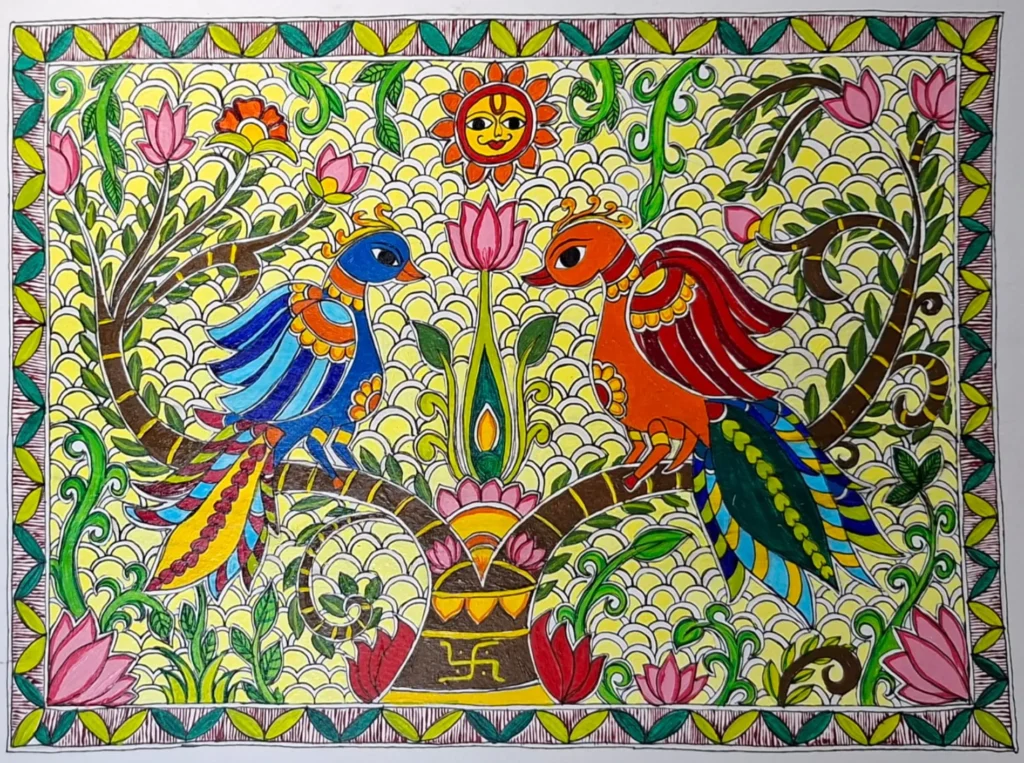
In Bharni paintings, defined areas of the composition are filled with colour while the figures and patterns are outlined and decorated with detailed line work.
The result can be bright and lively without losing the decorative character that runs through Madhubani painting more broadly.
Our Twin Peacocks & Lotus painting is a good example of Madhubani Bharni artwork. It features two colourful peacocks facing each other, lotus flowers and an intricate arrangement of decorative patterns.
View Twin Peacocks & Lotus – Original Madhubani Bharni Painting
Kachhni Style: The Beauty of Fine Lines
If Bharni catches your eye with colour, Kachhni tends to catch it with line work.
Kachhni is known for fine lines, hatching and intricate patterns. The artist builds an extraordinary amount of detail out of relatively simple elements.
Our Harmony of Fishes painting takes this approach, using black paint and detailed line work to create a fish-centred composition.

View Harmony of Fishes – Original Madhubani Kachhni Painting
Seeing Bharni and Kachhni side by side is a good way to understand just how differently two Madhubani paintings can look while belonging to the same broader tradition.
What Do Artists Paint in Madhubani Art?
There’s a wonderful variety in Madhubani subjects.
You may come across paintings featuring:
- Fish
- Peacocks and other birds
- Flowers and leaves
- Trees
- Animals
- Human figures
- Geometric designs
- Decorative borders
- Scenes inspired by traditional life
Some subjects show up again and again in Madhubani art, but their treatment can vary a lot from one artist to another.
It’s also worth keeping in mind that the meaning of a motif can shift depending on the artist, region and context. A peacock, fish or flower shouldn’t automatically be read one fixed way just because it appears in a Madhubani painting.
Sometimes the most enjoyable way to appreciate a painting is simply to notice how the artist has used the subject, lines and patterns to build the composition.
What Materials Are Used?
The materials used in Madhubani painting have changed over time.
Traditional works were often made using locally available materials and colours prepared from natural sources. Modern artists may use commercially available paints and work on paper, canvas, cloth and other surfaces.
That means two Madhubani paintings can differ not only in artistic style but in materials too.
If you’re buying an original painting, check the product details carefully. The medium, surface, dimensions and technique should ideally be stated clearly.
For example, our Twin Peacocks & Lotus artwork is hand-painted with acrylic colours on 230 GSM paper.
Original Handmade Painting or Print?
This is one of the first things I’d check when buying Indian folk art online.
A photograph of a painting can be reproduced thousands of times as a print. An original handmade painting, on the other hand, is a single artwork created by an artist.
Look closely at an original handmade painting and you may notice tiny variations in lines, paint application and patterns. These are natural marks of handmade work, not flaws.
Neither option is “better” for every buyer. A print can be an affordable way to decorate a room, while an original painting is a different proposition for someone who wants to own an individual piece.
If you’re specifically looking for an original Madhubani painting, read the product description carefully and look for clear information about whether the work is original, handmade or a reproduction.
How to Choose a Madhubani Painting for Your Home
Choosing a painting is partly about the artwork itself and partly about the room where it will live.
Start with size. Measure the wall before ordering, especially if you plan to frame the artwork later.
Then think about colour. A brightly coloured Bharni painting can become a strong focal point in a neutral room, while a mostly black-and-white Kachhni piece creates a very different mood.
Subject matters too. You might prefer flowers, birds, fish, trees, or simply an abstract arrangement of traditional patterns.
And finally, look at the details. If the painting is handmade, close-up photographs will tell you far more about the artist’s line work and finishing than a single small product image ever could.
How to Care for a Madhubani Painting on Paper
Paper artwork needs a little care, especially in a warm or humid environment.
Keep your painting away from:
- Direct and prolonged sunlight
- Water and moisture
- Damp walls
- Excessive heat
- Areas where it can easily be touched or damaged
If you decide to frame the painting, choose a suitable frame and protective glazing. Good framing makes the artwork easier to display while also protecting it from everyday handling.
For an original artwork, keeping it in a clean, dry environment is one of the simplest things you can do to help preserve it.
Why Handmade Madhubani Art Is Worth Appreciating
What I find genuinely interesting about Madhubani painting is the relationship between the overall image and the tiny details.
From a distance, you see the subject and the colours. Move closer and the painting reveals another layer — lines inside the figures, repeated patterns, carefully decorated spaces and small elements you may not notice at first.
That’s also what sets handmade art apart from mass-produced décor. The person who made the painting worked through thousands of small decisions along the way.
Every original painting ends up slightly different because of it.
For a home, that can make the artwork feel far more personal than something produced in identical copies.
Explore Madhubani Art at HIM ART GALLERY
At HIM ART GALLERY, we’re building a collection of Indian handmade paintings that celebrates the variety of traditional and contemporary Indian art.
Our Madhubani collection currently includes both colourful Bharni work and detailed Kachhni artwork.
Twin Peacocks & Lotus is a colourful Madhubani Bharni painting featuring two peacocks, lotus flowers and intricate decorative patterns.
Harmony of Fishes is a black-and-white Madhubani Kachhni painting with detailed line work and a fish-centred composition.
Both artworks are original handmade paintings on paper, sold unframed.
Explore Our Madhubani Collection
Frequently Asked Questions
Is Madhubani art the same as Mithila painting?
Madhubani painting is also commonly called Mithila painting because of its association with the Mithila region of Bihar.
Where does Madhubani art come from?
Madhubani art is associated with the Mithila region of Bihar, India.
What is Bharni Madhubani painting?
Bharni is a Madhubani style known for filling defined areas of the composition with colour, combined with outlines and decorative detailing.
What is Kachhni Madhubani painting?
Kachhni is known for fine line work, hatching and intricate patterns.
Are all Madhubani paintings handmade?
No. Madhubani designs are also reproduced as prints and other products. If you want an original, check the individual product description.
Can Madhubani paintings be framed?
Yes. Paper Madhubani paintings can be framed for display and protection, which is especially useful for preserving an original artwork long-term.
How should I care for a Madhubani painting on paper?
Keep it dry and away from prolonged direct sunlight, moisture, heat and unnecessary handling. Framing can add extra protection.
Final Thoughts
Madhubani art is easy to recognise, but it becomes much more interesting once you take the time to look closely.
The bold colours of Bharni, the fine lines of Kachhni, and the many ways artists arrange familiar subjects give this tradition a remarkable range.
If you’re new to Indian folk art, Madhubani is a wonderful place to start. And if you already appreciate it, looking closely at an original handmade painting can reveal something new every time.
Explore original Madhubani paintings at HIM ART GALLERY.